
A Lightweight Adaptive Decision Layer for Existing Systems
Drop-in Intelligence is a lightweight adaptive decision technology for industrial and technical systems.
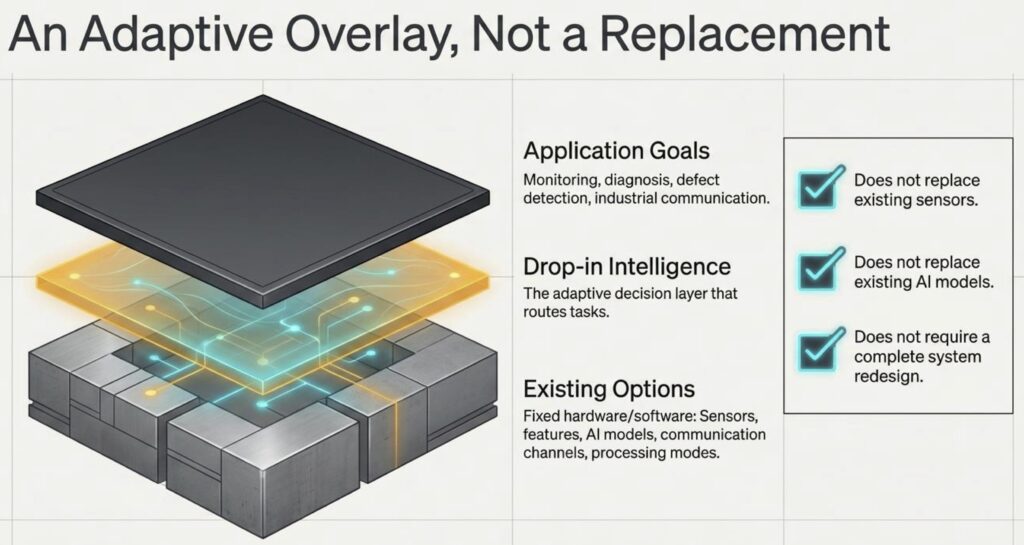
It is designed to work as an additional decision layer within existing systems. It does not replace sensors, AI models, communication infrastructure, monitoring systems, or control systems. Instead, it helps the system decide which available option should be selected under changing conditions.
Many real-world systems repeatedly face questions such as:
Which sensor should be used now?
Which model is worth running?
Which communication channel should be selected?
Which inspection point should be prioritized?
Which operating mode is most suitable under current conditions?
Trying all options continuously can waste energy, computation, bandwidth, sensing capacity, and time. Fixed rules may also fail when environments change.
Drop-in Intelligence addresses this problem by providing a compact adaptive decision layer that selects, evaluates, and updates choices based on feedback.
Core Idea
The core idea is simple:
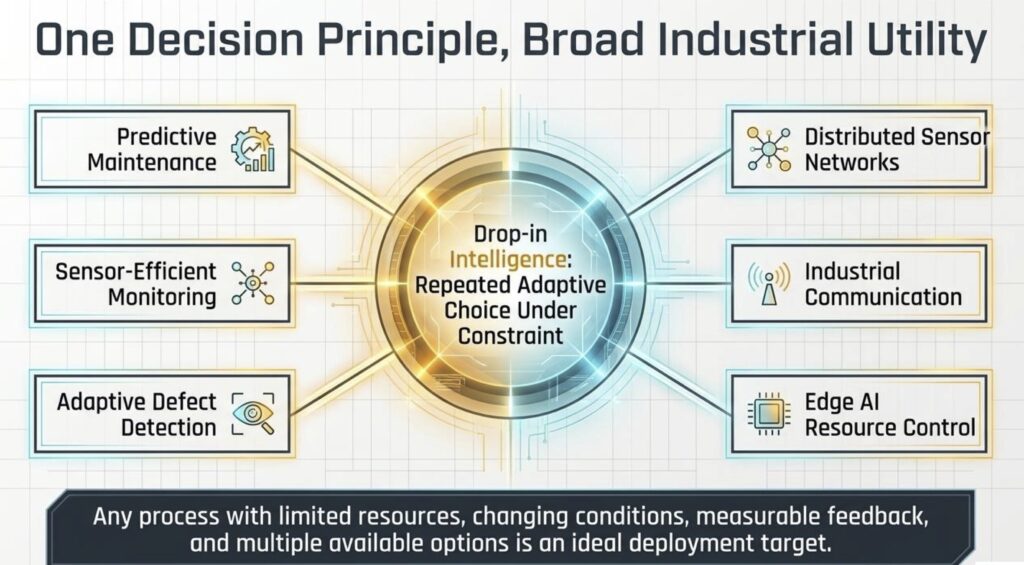
Existing systems already have multiple possible options. Drop-in Intelligence helps choose the right option at the right time. This makes it suitable for systems with limited resources, changing conditions, measurable feedback, and repeated decision bottlenecks.
The approach is grounded in long-term research on adaptive decision-making, physics-grounded learning. In this view, decision-making is not treated only as conventional machine learning rules or a large AI model, but as a physical adaptive process that can be implemented through compact dynamic principles.
Application Areas
Drop-in Intelligence can support applications such as:
Intelligent Maintenance
Adaptive selection of sensing, inspection, or monitoring strategies for maintenance-related decisions.
Anomaly Detection
Adaptive selection of signals, models, or processing modes for detecting abnormal behavior under changing conditions.
Communication Optimization
Dynamic selection of communication channels or operating parameters in industrial and IoT environments.
Resource-Aware Operation
Reduction of unnecessary sensing, computation, communication, or inspection effort while maintaining useful system performance.
Energy-related Adaptive Control
Adaptive parameter selection for vibration systems, energy harvesting, and low-power operation under non-stationary external conditions.
Current Stage
Drop-in Intelligence has advanced beyond a purely conceptual stage.
Initial validation has been completed within the Fraunhofer ecosystem, and the project is now moving into collaboration discussions for practical industrial applications.
The current focus is to identify suitable industry pilot cases where adaptive decision-making can be tested in real operational environments.
We are looking for partners facing repeated-choice bottlenecks in areas such as intelligent maintenance, anomaly detection, distributed sensing, industrial communication, sensor-efficient monitoring, and resource-constrained operation.
Prior Demonstrations and Initial Validation
The decision principle behind Drop-in Intelligence has already shown practical potential in applied research and validation settings.
Prior demonstrations include about 35% power reduction in real-world BLE communication environments and about 30% enhancement in vibration-based energy harvesting.
Initial validation within the Fraunhofer ecosystem further indicated that, in selected industrial decision scenarios, more than 50% cost reduction may be achievable by avoiding unnecessary sensing, computation, inspection, or model execution.
These results motivate the next step: identifying industry pilot cases where adaptive decision-making can be tested under real operational conditions.
Industry Pilot Direction
The ideal pilot case has three features:
- multiple available options, such as sensors, models, channels, inspection points, or operating modes;
- measurable operational cost, such as energy, bandwidth, computation, time, inspection effort, or sensing cost;
- feedback data that allows adaptive decisions to be evaluated and improved.
A suitable pilot case does not need to be large. The most useful case is one with a clear repeated-choice bottleneck, measurable operational cost, and available feedback data.
We are currently seeking industry partners for pilot studies, feasibility projects, and applied collaboration toward real-world deployment.
For inquiries about Drop-in Intelligence, pilot studies, or collaboration opportunities, please contact:
info [at] ubin-int [dot] com